A comprehensive sports medicine review examining VO2 max as the ultimate longevity biomarker, progressive mechanical tension kinetics, exercise-induced myokine endocrine signaling, and clinical training prescriptions.

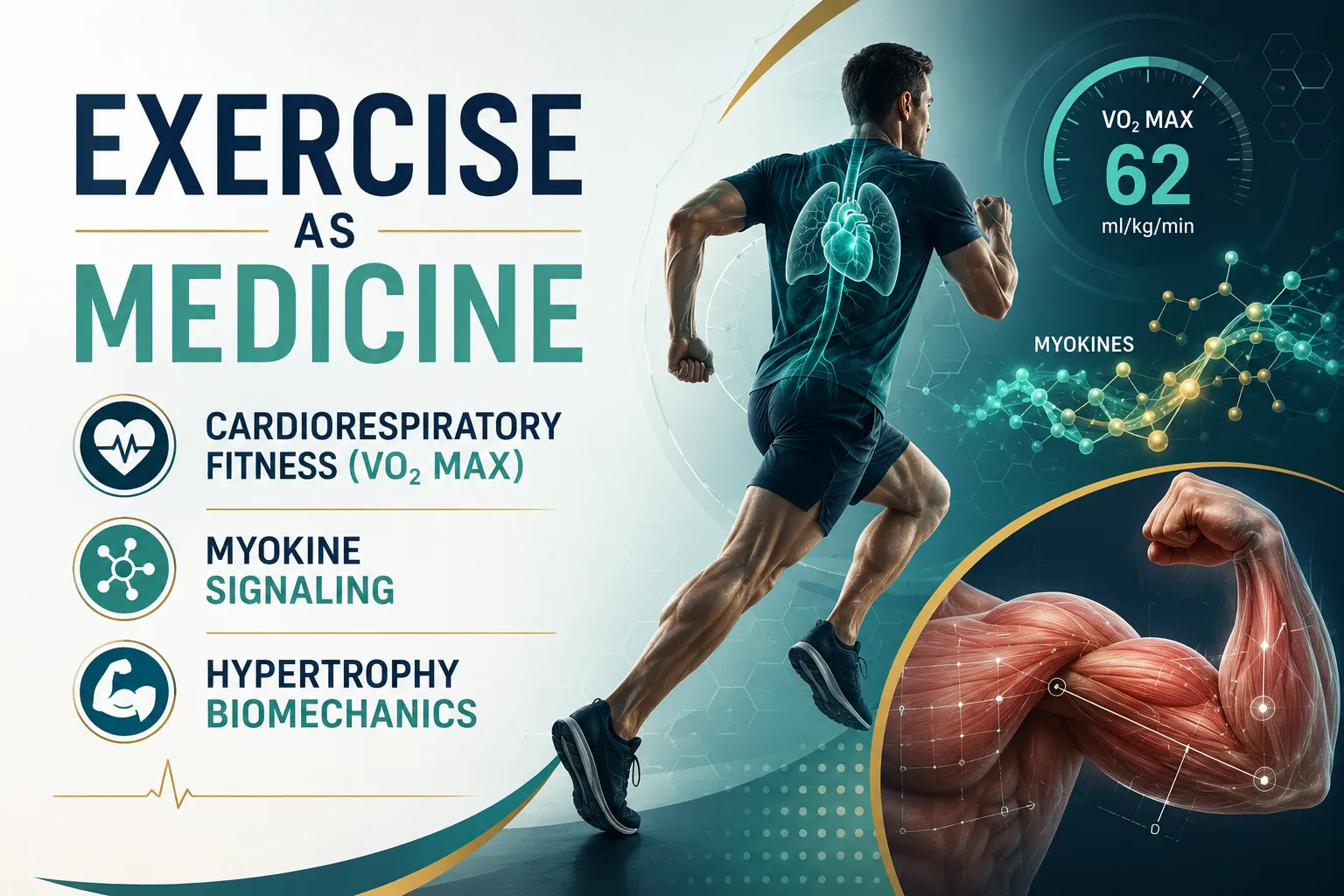
Throughout human history, physical movement was not a discretionary leisure activity; it was the uncompromising biological baseline for human survival. Every physiological organ system—from the vascular endothelium and myocardium to skeletal muscle, the endocrine pancreas, and the central nervous system—evolved under conditions of continuous, dynamic physical exertion. In modern sedentary civilization, the absence of physical movement represents an acute biological mismatch. Today, sports science, clinical physiology, and preventive cardiology have reached a definitive, unanimous consensus: exercise is not simply a tool for aesthetics or athletic performance; it is the single most potent, multi-target pharmacological intervention available in modern medicine, with no pharmaceutical equivalent capable of matching its pleiotropic benefits for healthspan and lifespan.
Among all clinical biomarkers evaluated in contemporary longevity medicine—including blood pressure, lipid profiles, smoking status, and coronary artery calcium scoring—maximal oxygen uptake (VO2 max) emerges as the single most powerful, independent predictor of all-cause and cardiovascular mortality. Measured in milliliters of oxygen consumed per kilogram of body weight per minute (mL/kg/min), VO2 max quantifies the integrated physiological capacity of the entire cardiovascular, respiratory, vascular, and muscular systems to extract, transport, and utilize oxygen for cellular ATP synthesis during exhaustive exercise.
Groundbreaking epidemiological studies encompassing hundreds of thousands of patients tracked across decades demonstrate an extraordinary, non-linear risk reduction: individuals progressing from the lowest quartile of cardiorespiratory fitness to the top elite percentile experience a nearly five-fold (four-hundred percent) reduction in all-cause mortality. This mortality benefit dwarfs the risk reductions achieved by quitting smoking, managing hypertension, or lowering LDL cholesterol. High cardiorespiratory fitness builds profound "physiological reserve"—an expansive biological buffer that enables individuals to survive major surgical procedures, catastrophic infections, and the inevitable physiological challenges of advanced chronological age.
Achieving high VO2 max requires physiological adaptations across two distinct anatomical domains: central delivery and peripheral extraction.
Central delivery is dictated primarily by maximal cardiac output—specifically, left ventricular end-diastolic stroke volume. Endurance exercise stimulates eccentric cardiac remodeling: the left ventricular chamber expands and myocardial compliance increases, enabling the heart to pump significantly larger volumes of oxygenated blood with each systolic contraction. Concurrently, systemic blood volume expands, increasing total circulating hemoglobin mass.
Peripheral extraction occurs within skeletal muscle myocytes and is dictated by capillary density and mitochondrial volume. Sustained endurance conditioning induces robust angiogenesis via vascular endothelial growth factor (VEGF), dramatically multiplying the number of capillaries per muscle fiber. Concurrently, elevated intracellular calcium and AMP/ATP ratios activate the transcriptional coactivator PGC-1alpha, driving rapid mitochondrial biogenesis. Mitochondria expand in both number and surface area, multiplying the density of cristae membranes and respiratory electron transport chain complexes, allowing skeletal muscle to extract up to ninety percent of delivered arterial oxygen.
While cardiorespiratory fitness ensures oxygen transport, skeletal muscle mass and functional muscular strength represent the physical armor of human longevity. The physiological stimulus for muscular hypertrophy is governed by three primary biomechanical mechanisms:
One of the most revolutionary discoveries in exercise physiology is that contracting skeletal muscle behaves as a vast endocrine organ, synthesizing and secreting specialized biochemical signaling peptides known as "myokines." During vigorous muscular contractions, myokines enter the systemic circulation to orchestrate systemic health across distant organs:
Accurate quantification of physical fitness requires objective, laboratory-grade diagnostic metrics:
An evidence-based, sustainable exercise regimen balances cardiovascular conditioning, progressive strength training, and neuromuscular mobility:
Your physical body is the tangible biological vehicle through which you experience the world. Physical strength, cardiorespiratory endurance, and structural joint integrity are not frivolous pursuits; they are the fundamental pillars of human autonomy, mental resilience, and healthspan. By viewing daily exercise as non-negotiable preventive medicine, you build a body capable of moving through life with effortless power, graceful agility, and enduring physical sovereignty.
Physician-scientist with 15+ years of research in cellular oncology, immunotherapy microenvironments, and cognitive reserve mechanisms.
0 Comments
Your email address will not be published. Newsletter subscribers are auto-approved; others are moderated for safety.